








Buying a vehicle through a Japanese car auction is one of the smartest ways to access thousands of high-quality used vehicles at competitive prices. However, before placing a bid, it’s essential to understand Japanese car auction grades and what they actually tell you about a vehicle.
Many first-time importers ask questions like:
The answer is that auction grades provide an excellent summary—but they’re only one part of the story.
A vehicle’s auction sheet, inspector’s comments, mileage, repair history, and condition diagram all play an equally important role in evaluating its true condition.
In this guide, we’ll explain how Japanese car auction grades work, what each grade means, and how Japan Auto Concierge helps buyers purchase vehicles with confidence.
A Japanese car auction grade is a standardized condition rating assigned by the auction house after a professional inspection. The grade provides buyers with a quick overview of the vehicle’s overall condition before bidding.
While grading systems can vary slightly between auction houses such as USS, TAA, JU, CAA, and ARAI, the grading scale is generally very consistent across Japan.
Along with the overall auction grade, buyers should always review:
The auction grade should always be viewed as a starting point—not the final decision. A complete review of the auction sheet provides a far more accurate understanding of the vehicle.
| Grade | Condition | Typical Buyer |
|---|---|---|
| S | Brand new or registered but unused | Buyers wanting virtually new vehicles |
| 6 | Nearly new with extremely low mileage | Premium buyers |
| 5 | Excellent condition with minimal wear | Exporters and retail buyers |
| 4.5 | Very clean with light signs of use | One of the most desirable grades |
| 4 | Good used condition with minor cosmetic wear | Best balance of value and condition |
| 3.5 | Average condition with moderate wear | Budget-conscious buyers |
| 3 | Noticeable cosmetic wear and age | Requires careful inspection |
| 2 or below | Significant wear, corrosion, or damage | Experienced buyers only |
| R / RA | Previous structural or accident repair | Professional evaluation recommended |
Grade S vehicles are essentially brand new. They are often registered but unused, with delivery mileage and no signs of wear.
Grade 6 vehicles are nearly new with exceptionally low mileage and almost no cosmetic imperfections.
Grade 5 vehicles are in outstanding used condition. They typically have very low mileage, minimal wear, and are highly sought after by both exporters and domestic buyers.
Grade 4.5 is widely regarded as one of the best grades available. These vehicles have been well cared for and generally show only minor signs of normal use.
Grade 4 vehicles represent excellent value for most buyers.
Although minor scratches, stone chips, or small cosmetic imperfections may be present, these vehicles are generally well maintained and mechanically sound.
Many experienced importers specifically look for Grade 4 vehicles because they offer an excellent balance between price and condition.
Grade 3.5 vehicles typically show more noticeable cosmetic wear.
While they may have scratches, dents, faded paint, or higher mileage, many remain mechanically reliable and can represent excellent value depending on their maintenance history and purchase price.
Grade 3 vehicles usually have significant cosmetic wear and signs of age.
These vehicles require a thorough review of the auction sheet and inspector’s comments before bidding.
Vehicles receiving Grade 2 or below often have substantial damage, corrosion, flood history, poor repairs, or other serious issues.
These vehicles should only be considered after careful inspection.
An R-grade or RA-grade indicates the vehicle has undergone structural or accident repairs.
Contrary to popular belief, an R-grade vehicle is not automatically a bad purchase.
Some repairs are professionally completed and have little impact on reliability, while others may significantly reduce long-term value.
This is where an experienced broker becomes extremely valuable.
Japanese Car Auction grades help buyers quickly compare thousands of vehicles and establish realistic expectations regarding condition and value.
However, two vehicles with exactly the same auction grade can differ significantly.
Factors such as maintenance history, paint condition, tire wear, underbody corrosion, interior cleanliness, and previous repairs all influence the vehicle’s overall quality.
For this reason, experienced buyers never rely solely on the auction grade.
The interior grade reflects the condition of the cabin and upholstery.
A clean interior is especially important for family vehicles and export customers looking for strong resale value.
Mileage should always be considered together with the auction grade.
A well-maintained Grade 4 vehicle with higher mileage may still be a better purchase than a lower-grade vehicle with fewer kilometres.
The auction inspector records observations about scratches, dents, paintwork, smoke odours, mechanical concerns, aftermarket modifications, and overall vehicle condition.
These comments often provide the most valuable information on the auction sheet.
If a vehicle carries an R or RA grade—or mentions repairs within the inspector’s comments—the work should be evaluated carefully before bidding.
The auction sheet includes a diagram identifying scratches, dents, repainting, waviness, panel replacement, and other exterior imperfections.
Learning to read this diagram helps buyers understand a vehicle’s true cosmetic condition.
Not necessarily.
While higher grades generally indicate cleaner vehicles, they aren’t always the best purchase.
For example:
The best choice depends on your intended use, expectations, and budget.
Japanese auction sheets contain technical terminology that can be difficult for overseas buyers to interpret.
Even experienced buyers often rely on knowledgeable brokers to identify hidden issues before bidding.
At Japan Auto Concierge, we help buyers by:
Our goal is to help every customer purchase with confidence and complete transparency.
Visit our How it Works page for details.
Yes. Grade 4 is generally considered one of the best value grades in Japanese vehicle auctions. Most Grade 4 vehicles are well maintained and only show normal signs of use.
Absolutely. Many Grade 3.5 vehicles offer excellent value when supported by a clean auction sheet, good maintenance history, and favourable inspector comments.
Not necessarily. An R-grade simply means the vehicle has undergone structural repairs. The quality of those repairs varies, making professional evaluation essential.
Grade 5 and Grade 4.5 are considered excellent. However, many experienced importers specifically seek Grade 4 vehicles because they provide the best balance between quality and price.
Yes, but they should never be the only factor in your decision. Always review the complete auction sheet, inspector’s notes, mileage, and vehicle condition diagram before bidding.
Understanding Japanese car auction grades is one of the most important steps when purchasing a vehicle from Japan.
While the auction grade provides an excellent starting point, the best buying decisions come from combining that information with a thorough review of the auction sheet, inspector’s comments, repair history, and expert guidance.
At Japan Auto Concierge, we help customers navigate every stage of the buying process—from sourcing vehicles and interpreting auction sheets to arranging inspections, export documentation, and worldwide shipping.
Whether you’re importing your first vehicle or expanding a dealership inventory, our team is committed to making the process transparent, straightforward, and stress-free.
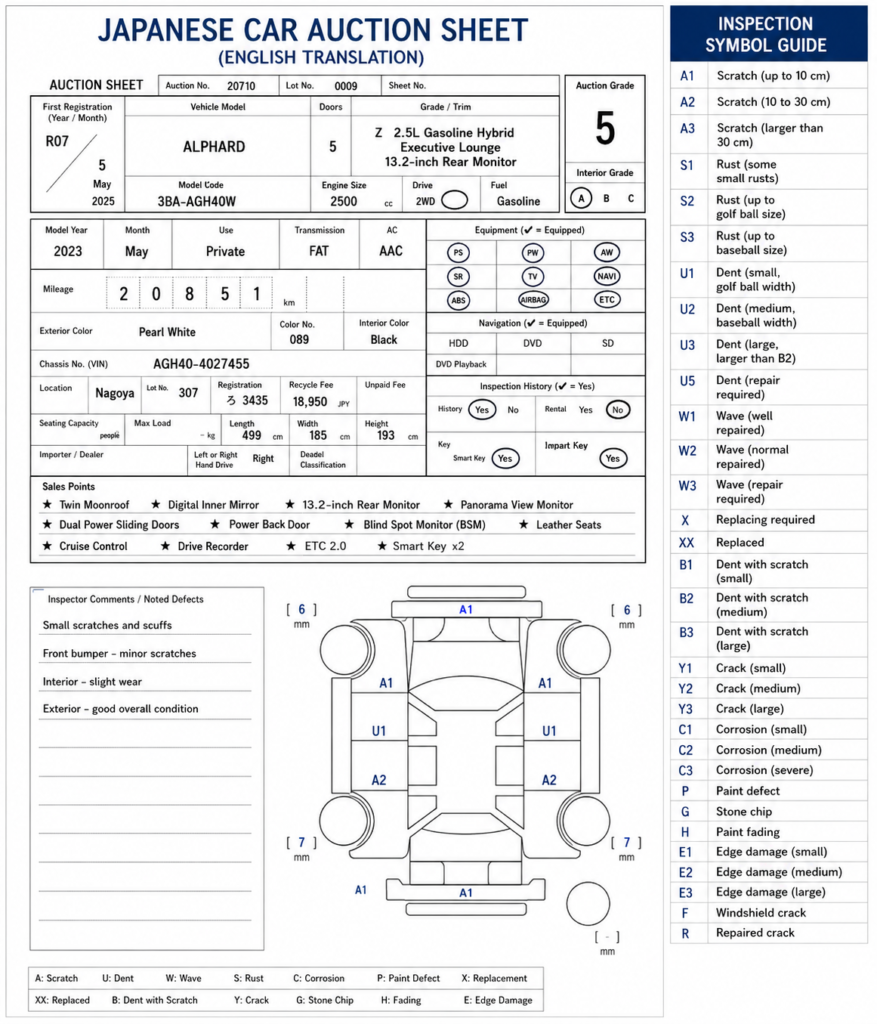
Example of a Japanese car auction sheet with an English translation of the auction grades, inspection symbols, and vehicle condition diagram.